
If you operate a POD (Print-on-Demand) business, dropshipping store, SaaS company, international eCommerce business, or manage multiple brands simultaneously, you’ve probably asked yourself this question:
How many PayPal Business accounts can one LLC open?
Is it limited to one account? Two accounts? Or can you have multiple?
This is a topic that many sellers misunderstand. A common misconception is that each legal entity—such as an LLC—is only allowed to own a single PayPal Business account. In reality, however, PayPal does not publicly state a fixed limit such as “one LLC can only have one PayPal Business account” or “each company can have a maximum of three accounts.”
What truly matters is not the number of accounts, but rather the purpose of each account, business transparency, and compliance with PayPal’s policies.
In other words, an LLC may operate multiple PayPal Business accounts, provided that each account supports a legitimate business activity, has a clear business purpose, and is not used to bypass PayPal’s limitations, reserves, risk controls, or other policies.
Does PayPal Limit the Number of Business Accounts for One LLC?
PayPal does not publish a specific policy stating that an LLC may only own one PayPal Business account. Instead, the company evaluates each case individually based on legitimate business needs and compliance with its policies.
In practice, PayPal is generally less concerned about how many accounts you have and more interested in questions such as:
- Does each account support a legitimate business activity?
- Is each account associated with a separate website, brand, or product line?
- Is the company’s legal information consistent across all accounts?
- Were the accounts created to bypass limitations, reserves, risk reviews, or continue receiving payments after another account was restricted?
If each account represents a genuinely separate business operation—for example, its own website, brand, customer base, and operational workflow—then maintaining multiple PayPal Business accounts may be considered acceptable.
However, if multiple accounts are created solely to circumvent PayPal’s policies, avoid reserves, bypass compliance reviews, or continue processing payments after another account has been limited, PayPal may review the entire group of related accounts associated with your business.
Rather than asking “How many PayPal Business accounts can one LLC open?”, sellers should focus on a more important question:
How does PayPal evaluate business risk, and how can you manage multiple accounts in a transparent and compliant way?
Why Might an LLC Need Multiple PayPal Business Accounts?
When a business is just starting, a single PayPal Business account is usually sufficient.
As the company grows, however, using one account for every operation can make financial management increasingly difficult.
Revenue

from multiple brands becomes mixed together, transaction records are harder to analyze, refunds and disputes become more complicated, and accounting teams may struggle to reconcile cash flow accurately.
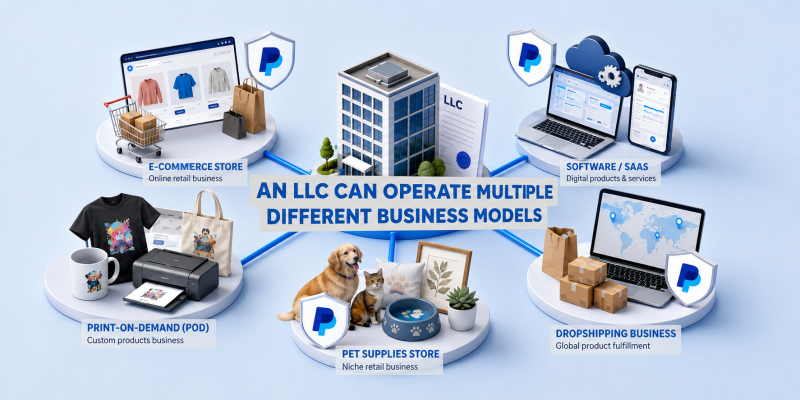
For these reasons, many businesses choose to separate different business segments by using different PayPal Business accounts.
eCommerce Fashion Store
A fashion brand selling apparel, accessories, or lifestyle products may process hundreds or even thousands of orders every day.
Using a dedicated PayPal Business account for that brand makes it easier to monitor revenue, manage refunds, resolve disputes, and evaluate business performance.
SaaS Business
Businesses that sell software, online tools, or subscription-based services have payment flows that differ significantly from traditional retail.
A dedicated PayPal Business account for the SaaS website helps simplify recurring revenue management, subscription reconciliation, and customer lifetime value (LTV) tracking.
When May PayPal Accept Multiple Business Accounts?
Having multiple PayPal Business accounts does not automatically violate PayPal’s policies.
The key requirement is that each account must represent a genuine business activity with a legitimate and clearly explainable purpose.
In other words, PayPal wants to see that each account is not simply a backup account created to bypass restrictions, but rather a reasonable part of your company’s operational structure.
Below are several best practices sellers should follow.
Each Account Should Be Linked to Its Own Website or Brand
Your website is one of the most important factors PayPal considers when evaluating the legitimacy and transparency of your business.
Each PayPal Business account should be connected to its own website, landing page, or brand.
The website should clearly include:
- Company information
- Payment policy
- Refund and return policy
- Privacy policy
- Terms of Service
- Contact information
A professional website not only increases customer trust but also helps streamline PayPal’s verification process.
Use a Dedicated Business Email for Each Brand
Each brand should have its own customer support email instead of sharing a single email address across multiple PayPal accounts.
This makes it easier for PayPal to recognize that each account supports a different business operation.
It also improves customer service management, dispute handling, and transaction notifications.
Maintain Separate Transaction Histories
This is one of the most important factors.
If one PayPal account is created for Brand A, all transactions processed through that account should originate from Brand A’s website.
Likewise, the PayPal account for Brand B should only receive payments generated from Brand B’s website.
Using multiple websites interchangeably with multiple PayPal accounts may make it difficult for PayPal’s risk management system to identify the true source of your revenue.
Over time, this may negatively impact your verification process and reduce the overall trustworthiness of your accounts.
Keep Legal Information Consistent Across All Accounts
Although each PayPal account may support a different brand, the company’s legal information should remain consistent across all accounts.
If there are discrepancies in legal details, PayPal may request additional documentation to verify ownership or conduct a more in-depth account review.
While this does not necessarily result in immediate account limitations, it can make the verification process longer and more complex.
How to Manage Multiple PayPal Business Accounts More Safely
Opening multiple PayPal Business accounts is not the hardest part. The bigger challenge is managing them in a transparent, consistent, and compliant way while minimizing operational risks.
Below are several best practices that every business should follow.
Enable Two-Factor Authentication (2FA)
Two-Factor Authentication (2FA) is one of the most basic yet essential security measures.
It helps protect your account from unauthorized access, safeguards your funds, and significantly improves account security. For businesses receiving international payments, enabling 2FA should be considered a standard practice rather than an option.
Avoid Logging In from Too Many IP Addresses, Devices, or Countries
If an account is accessed from Vietnam today, the United States a few hours later, and then another country shortly afterward, PayPal’s security system may identify this as unusual activity.
If your business has a remote team, establish a consistent login process and avoid frequently changing devices, browsers, or login locations. When multiple team members need access, use PayPal’s user management and permission features instead of sharing the primary account credentials.
Assign User Permissions Properly
Avoid allowing multiple employees to share the same administrator account.
If different team members handle payments, customer service, or dispute management, assign appropriate user roles based on their responsibilities. Only grant access to employees who genuinely need it, and limit permissions to the minimum required for their tasks.
This not only improves account security but also creates a clear audit trail for internal reviews.
Monitor Disputes, Refunds, and Chargebacks Regularly
PayPal evaluates risk based not only on your legal business information but also on your operational performance.
Metrics such as dispute rates, refund rates, chargebacks, unresolved customer complaints, and response times can all influence your account’s overall trust level.
Each brand should therefore establish clear internal procedures to:
- Monitor customer complaints.
- Process refunds according to company policies.
- Respond to disputes promptly.
- Upload tracking numbers for physical product orders.
- Maintain organized records of shipping confirmations, invoices, and customer communications.

Common Mistakes That Can Lead to PayPal Business Account Limitations
Simply owning multiple PayPal Business accounts under the same LLC is not necessarily a problem. What matters to PayPal is how those accounts are used.
If each account supports a separate brand or legitimate business model and is operated transparently, the overall risk is generally lower. However, creating multiple accounts primarily to circumvent PayPal policies may trigger a review of all related accounts associated with the business.
Opening Multiple Accounts to Avoid a Reserve
A reserve is money that PayPal temporarily holds to reduce financial risk for certain industries, business models, or accounts with limited transaction history.
Instead of improving operations, reducing disputes, and building a healthy transaction history, some sellers create new accounts and redirect revenue to avoid reserves. This is a high-risk practice and should be avoided.
If PayPal determines that multiple accounts are being used to bypass reserve requirements, it may review the entire network of related accounts.
Creating a New Account After an Existing One Is Limited or Restricted
A common mistake is creating a new PayPal account immediately after an existing account becomes limited or requires verification.
This rarely solves the underlying issue. If PayPal determines that the new account belongs to the same business and was created to bypass the review process, all related accounts may be affected.
In many situations, the better approach is to cooperate with PayPal, provide the requested documentation, and complete the verification process.
Using One Website with Multiple PayPal Accounts
Accepting payments for the same website through multiple PayPal accounts can make it more difficult for PayPal to understand your business model.
If your business operates multiple brands, each brand should ideally have its own website or dedicated landing page and use its corresponding PayPal account. This creates a clearer connection between your business, payment activity, dispute management, and account verification.

Mixing Revenue Between Different Brands
Some businesses create multiple PayPal accounts but later allow payments to flow across different websites.
For example, a customer purchases from Website A but completes payment through the PayPal account associated with Website B.
This practice complicates financial reconciliation, creates inconsistencies in transaction records, and may raise concerns about the transparency of your business operations.
RENT PAYPALProviding Inconsistent Business Information
Another common mistake is using the same LLC while submitting inconsistent legal information across different PayPal accounts.
Examples include differences in the registered business name, business address, authorized representative, or inconsistent use of the EIN.
These inconsistencies can make the verification process more complicated and increase the likelihood that PayPal will request additional documentation before approving or maintaining your accounts.
Conclusion
An LLC Can Have Multiple PayPal Business Accounts—As Long as There’s a Legitimate Business ReasonPayPal does not publicly specify a fixed limit on how many PayPal Business accounts a single LLC can open. So, in practice, the answer is not simply “one,” “two,” or “three.” Instead, each account must serve a legitimate, clearly defined, and transparent business purpose.
In short, the real question is not how many PayPal Business accounts an LLC can have, but whether the business can clearly justify the purpose of each account and operate each one in a transparent and compliant manne
EasyPay onBoard – Your success is our satisfaction