
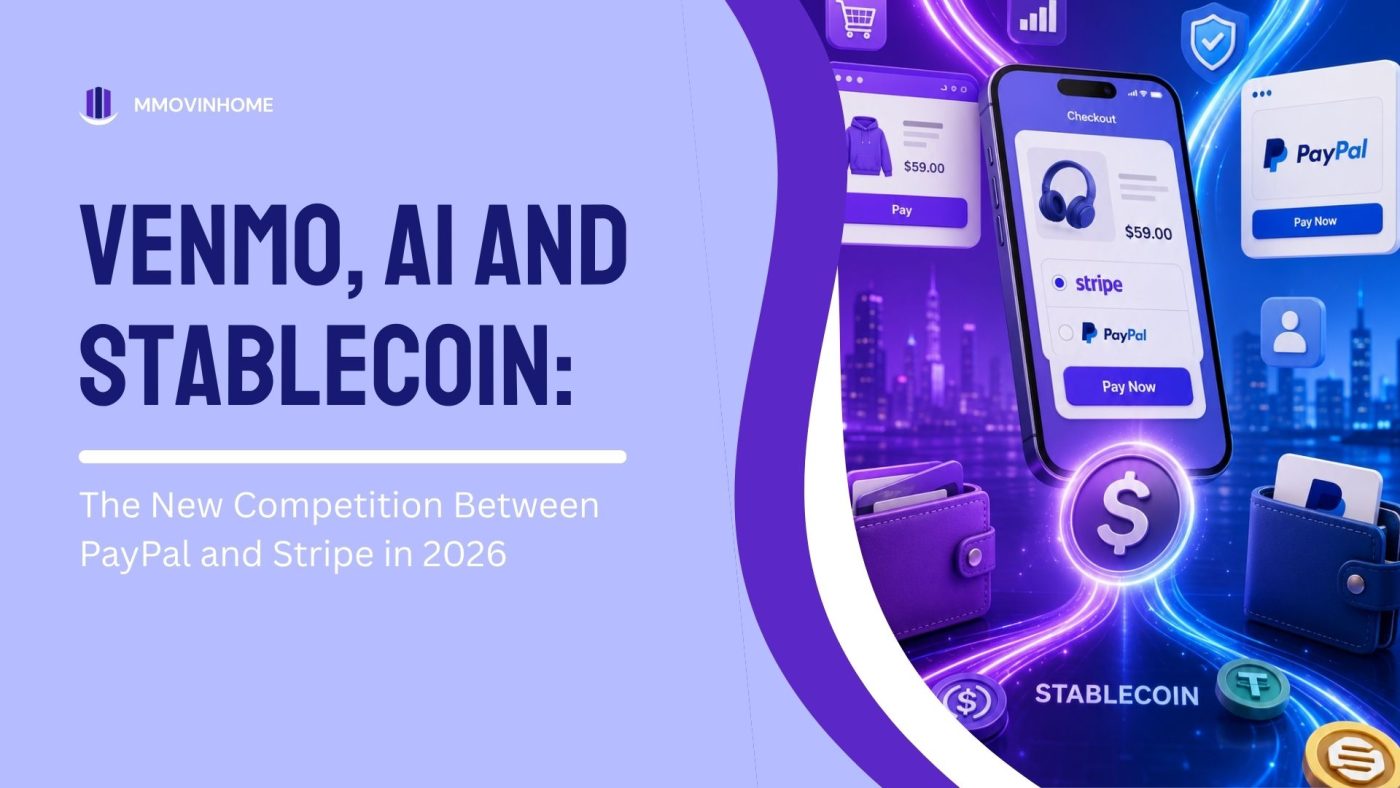
Over the past few years, the way we send and receive money has changed dramatically. While international payments once took several days to process, many transactions can now be completed within seconds.
This transformation is being driven by three major factors:
- Artificial Intelligence (AI) is helping automate processes and reduce transaction risks.
- Stablecoins allow money to move as quickly as the internet while maintaining stable value.
- Global payment platforms such as PayPal and Stripe are competing to control the flow of digital money.
In this race, two of the most prominent players are PayPal (through Venmo) and Stripe.
What Is a Payment Gateway?
A payment gateway acts as the bridge between customers and businesses, enabling money to move securely from one party to another.
Example:
- A customer places an order online.
- The payment gateway processes the transaction.
- The funds are transferred to the seller.
When a payment gateway is not stable, businesses may face issues such as:
- Funds being held
- Reserve requirements
- Delayed payouts
For online businesses, payment infrastructure can be just as important as marketing and sales.
What Is Venmo in the PayPal Ecosystem?
Venmo is a popular payment application in the United States that was originally designed for simple peer-to-peer money transfers.
By 2026, however, Venmo has become a key part of PayPal’s broader digital finance strategy.
Rather than being just a “split-the-bill” app, Venmo is evolving into:
- A multifunction digital wallet
- A shopping payment platform
- An international payment solution
- An integrated personal finance tool
What Does AI Mean in Payments?
AI in the payment industry is not about chatbots. Instead, it refers to intelligent systems that help:
- Detect fraudulent transactions
- Predict risk levels
- Improve payment approval rates
- Reduce order processing failures
Simply put, AI helps businesses retain more revenue while requiring less manual effort.
What Is a Stablecoin?
A stablecoin is a type of cryptocurrency that is pegged to a traditional currency, such as the U.S. dollar.
For example:
- 1 USDC ≈ 1 USD
Key benefits include:
- Near-instant transaction speeds
- Lower fees compared to traditional banking systems
- Reduced price volatility compared to typical cryptocurrencies
Many experts now view stablecoins as the “internet version” of the U.S. dollar.
PayPal and Venmo: Focused on Consumers
PayPal is transforming Venmo from a simple money-transfer application into:
- A multifunction digital wallet
- A shopping payment solution
- A smart personal finance platform
The Role of AI and Stablecoins in Venmo
PayPal is integrating:
- AI to analyze spending behavior
- Stablecoins to accelerate international money transfers
The goal is to turn Venmo into a simplified digital banking experience for everyday users.

Stripe: Payment Infrastructure for the Internet
Unlike Venmo, Stripe is not focused on consumers.
Instead, Stripe builds payment infrastructure for:
- E-commerce businesses
- SaaS companies
- Global freelancers
- AI and technology platforms
How Does AI Work Within Stripe?
Stripe uses AI to:
- Increase payment success rates
- Reduce losses caused by failed transactions
- Automatically detect fraud
- Optimize business cash flow
For many companies, AI-driven payment optimization directly impacts profitability.
Stablecoins in Stripe
Stripe is increasingly leveraging stablecoins as a new payment layer to:
- Enable faster cross-border payments
- Reduce dependence on traditional banking systems
- Support global commerce 24/7
This approach aligns with Stripe’s vision of building financial infrastructure for the internet economy.

Real-World Challenges Faced by Online Sellers
Despite rapid technological advancement, many online entrepreneurs still face practical payment challenges:
- Unexpected payment holds
- Reserve requirements that withhold a portion of revenue
- Delayed payouts ranging from days to weeks
- Transaction limitations when scaling revenue
These issues are especially common in industries such as:
- Dropshipping
- Print on Demand (POD)
- Digital products
- Affiliate marketing
When cash flow is interrupted, business growth often slows down as well.
PayPal vs. Stripe: Two Different Approaches
PayPal (Venmo)
- Focused on individual consumers
- Building a simplified financial ecosystem
- Combining AI and stablecoins to improve user experience
Stripe
- Focused on businesses and developers
- Providing global payment infrastructure
- Using AI to maximize revenue and reduce risk
- Building financial rails for the internet economy
The Most Important Question: Stability of Cash Flow
In real business operations, the key issue is not which technology is more advanced.
The real questions are:
- Will payments arrive on time?
- Will funds be held unexpectedly?
- Is the payment system stable enough to support growth?
Many successful sellers still struggle because their payment infrastructure is not aligned with their business model.
Choosing the Right Payment Gateway for Sustainable Growth
Rather than choosing PayPal or Stripe simply because they are popular, many businesses now prioritize:
- Payment solutions tailored to their industry
- Reliable payout systems
- Lower risk of holds and reserve requirements
- Better support for international expansion
This growing demand has also contributed to the rise of payment gateway setup and rental services.
Conclusion
The competition between PayPal (Venmo) and Stripe in 2026 is about far more than AI or stablecoins. It represents a fundamental shift in how money moves through the digital economy.
- PayPal is focused on instant consumer payments.
- Stripe is building financial infrastructure for global businesses.
- AI and stablecoins are transforming the speed and efficiency of transactions.
However, one principle remains unchanged: The best payment system is not necessarily the most advanced one it is the one that provides the greatest stability for your business model.